Planning & recruitmentUser interviewsSynthesis & root causesHandoff

How we turned an error list into a helpful resolution guide

Overview

The company develops a platform for managing short-term rental properties — hotels, condos, houses, and apartments. Owners, property managers, and pricing teams use it to keep their listings consistent across travel sites like Airbnb, Booking, and Expedia, and to avoid overbookings when the same property is sold on several channels at once.

Goal

Property managers were running properties full of unresolved errors — sometimes hundreds per account — while those same properties kept taking bookings. The goal was to understand why the errors built up, why users didn't act on them, and how to make them easier to resolve without contacting support.

Problem

The product team had been aware of this for a long time. They could see accounts with large numbers of unresolved errors, but no one had pinned down why users left them unaddressed. My job was to understand the behaviour and turn it into specific, technical causes the team could build against: moving from a user saying “this is overwhelming” to a concrete reason in the system.

Role

UX / Service Experience Researcher

Duration

7 weeks

Responsibilities

Research planning
UX audit
Session review
Survey design & analysis
Competitor analysis
Insight synthesis
Recommendations

Short project summary

01. Planning & recruitment

I wrote the research plan, set the questions, and built the interview list from real data — sorting accounts by error volume and including the biggest clients so their view was represented.

02. User interviews

I ran 15 semi-structured interviews across different user types, each combining open questions with a live walkthrough of the person’s own account inside the product.

03.Synthesis & root causes

I coded the transcripts as I went and grouped the findings into 30 pain points. I grouped those by theme, then narrowed them to four root causes behind the behaviour.

04. Handoff

I ran an insight presentation and a workshop where each problem was assigned to an owner, turning the research into a sequence of follow-on projects.

01. Planning & recruitment

The request from the product team was broad — more of a direction than a brief. Before starting, I worked with the product managers to narrow it into something researchable. So from general "why are there so many errors,"questions we’ve come to two more specific ones: ”Why users disengaged from errors they could see”, and “What made the resolution process feel unmanageable?”.

Research questions

Why users disengaged from errors they could see?

What made the resolution process feel unmanageable?

How can we improve the resolution workflow on the platform?

I chose semi-structured interviews because a fixed script would have locked in assumptions about a cause we didn't understand yet, and I needed room to follow whatever the users led me to.

To recruit, I started from the data. I looked at how many errors accounts had on average and which error types were most common, then sorted accounts by the highest volume — those users were living with the problem most acutely and had the most to tell me. I also included the biggest clients even when they weren't at the top of that list, since they carried the highest business stakes and the most complex setups.

The scale explains much of the behaviour on its own. Users managing large portfolios could open their accounts and face hundreds, sometimes thousands of unresolved errors at once.

02. User interviews

I ran 15 interviews across the different user types — property managers handling large portfolios, pricing specialists, and smaller owners doing everything themselves. Each session started with general questions about how they work and what an ideal process would look like for them, then moved into their live account so I could watch what they actually did, what they opened, and what they skipped.

That probing is where the less obvious findings came from. Narrowing down one "it's overwhelming" led to something specific: many users were non-native English speakers, the errors weren't translated, and the wording was too complex for them to follow. None of that showed up in behavioural data. It surfaced by following that reaction with another question.I recorded and transcribed every session, and coded them between interviews while the details were still fresh — the hesitations, the tone, the things someone did on screen that transcripts alone don't hold. That way I captured notes that would have faded if I'd left everything to the end.

Users rarely name the real problem on their own. Someone would scroll fast through a long list of errors and say something like "I look at all this and have no idea where to start — I don't have time to read through it, I have other work to do." When that happened, I'd slow the session down: repeat back what they'd just said, then ask them to point at the specific thing behind it — was it the way the errors were explained, the way the screen looked, or simply the number? Most users weren't technical, so I gave them concrete options to react to. They could recognise what frustrated them once I put the possibilities in front of them.
03. Synthesis & root causes

By this stage, the vague reactions from the interviews had already been narrowed down with users into specific, concrete problems in their own words. The synthesis worked with that material: grouping the specific points, finding the patterns across users, and tracing each one to a cause in the system. That meant checking what users described against how the platform actually worked underneath

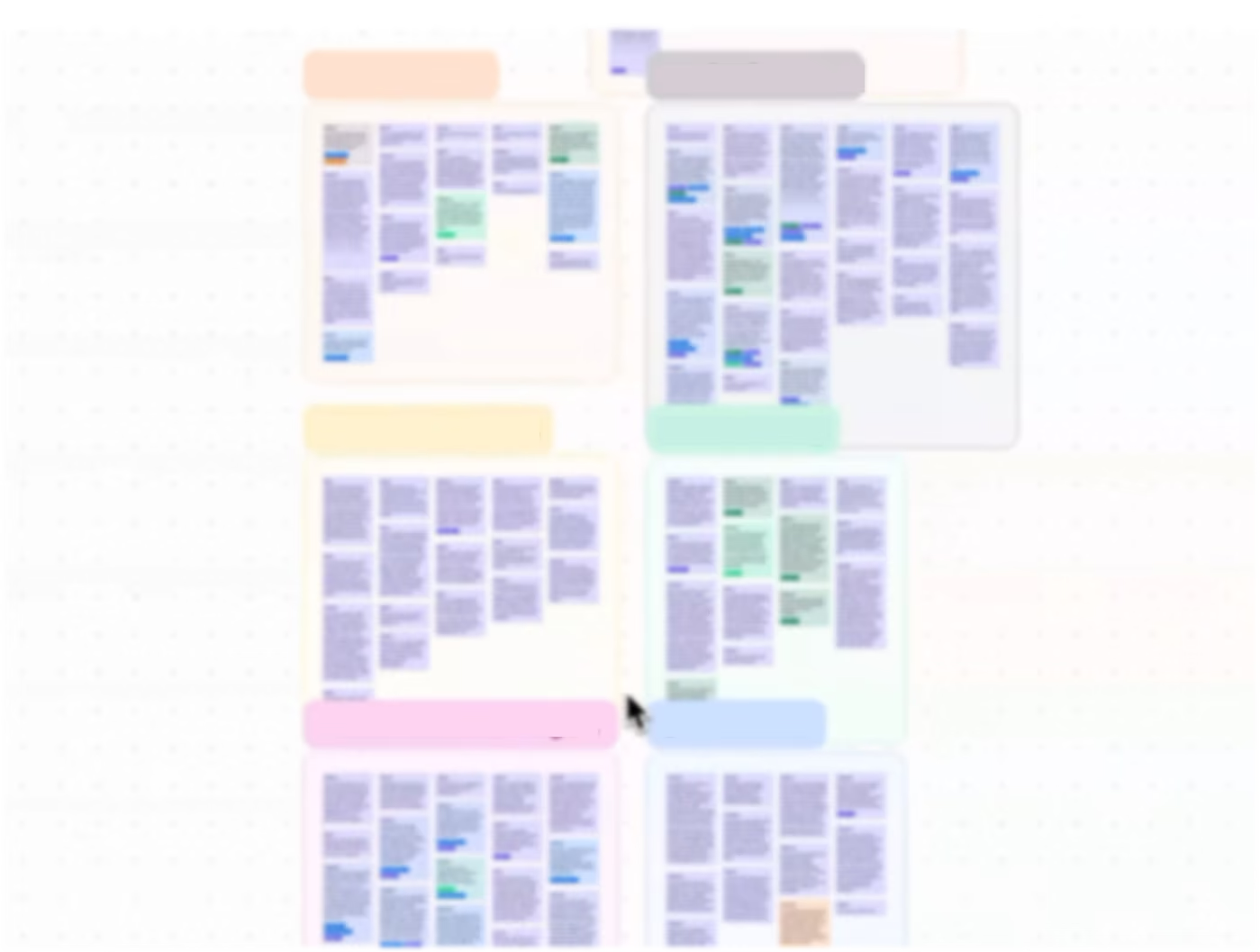
The interviews produced 30 specific pain points, grouped into clusters by theme. One example was an 'error copy' cluster — untranslated errors, empty errors with no description, and wording too complex to understand — which later went to a Technical Writer. Those clusters narrowed to different root causes that, together, explained why people let errors pile up.

Insights
The error count was inflated by the system itself

Every notification in the system was shown as an error, with no separation between a real error, an alert, and a simple notification. The same error was also listed once per room, or repeated several times per house, so a single underlying issue could appear dozens of times. The number everyone had been treating as a count of real problems was largely an artefact of how the system displayed them. The direction was to show each error type once and list the rooms and houses it affected underneath, so one action could clear it everywhere

Everything looked equally urgent

Not all errors mattered the same to users. The ones they cared about could pull a listing offline, block reservations, show wrong pricing, or touch country-specific regulations. Errors like a low-quality photo, a listing name that ran too long, or a few missing amenities sat much lower for them. The system gave no way to tell these apart, so a critical error and a cosmetic one appeared side by side. The direction was to turn error types into visible filters, so people could deal with what mattered first.

Fixing was slow, manual and demotivating

Seeing 500 or 1,000 fixes needed was simply demoralising. Users assumed it meant an enormous amount of manual work and decided it was easier to leave it as it was. Each error had to be fixed one at a time, which was unmanageable at their scale. The direction was bulk actions — applying the same fix across many rooms and properties at once. This one came straight from users. Several said, in their own words, that they wished they could solve one problem across all their properties in a single go.

Separating the problem into distinct causes made its shape clear. It touched different parts of the experience at once. These were the architecture of the error page, the wording of the errors, the lack of any prioritisation, and the manual, one-by-one process for making fixes. Each needed a different kind of solution, which is why no single change had ever resolved it."

04. Handoff & outcome

I presented the insights to the team and ran a workshop where we turned them into action. We went through each problem, agreed what to do, and gave every one an owner. This part mattered to me. Research that no one owns tends to quietly disappear, so I wanted every finding to leave the room with someone responsible for it.

Each of the four causes became its own piece of work: a redesigned error page, simpler error wording with helpful links, and bulk actions added across the product. I stayed involved after the research, working with the designer to shape and check the new error page against what we'd found.

The research took a question the team had struggled with for a long time and turned it into clear causes, a set of priorities, and real changes that were built into the product.

A note on scope

This is one part of a larger body of work. The research led to several follow-on projects, and I've kept this case study to the discovery phase. The projects that came out of it are their own stories.

Helping Travelers Search Smarter

Continue